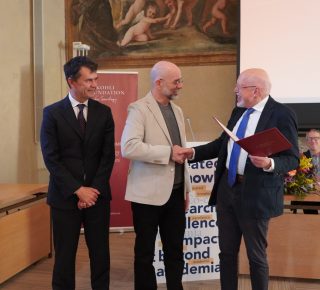
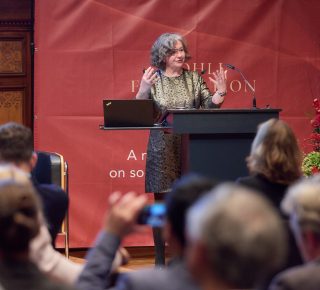
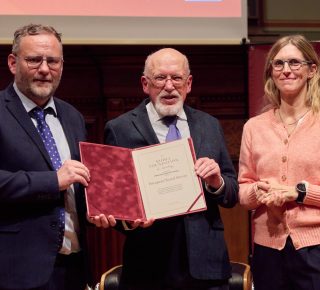
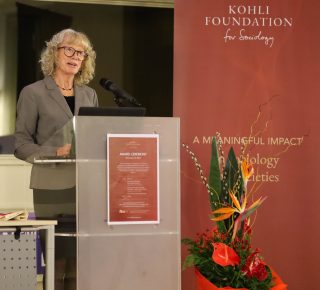
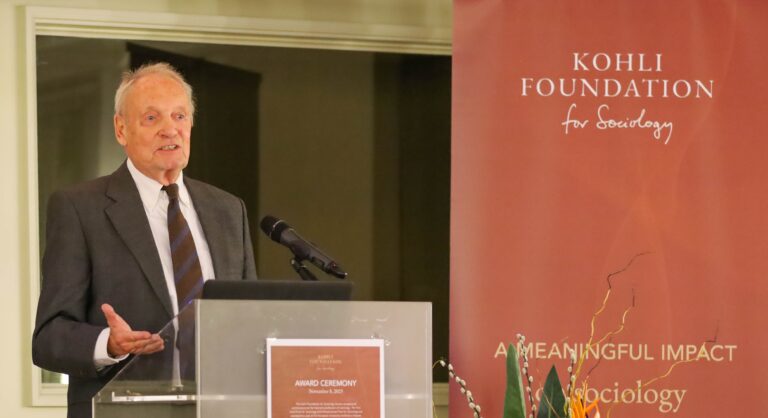
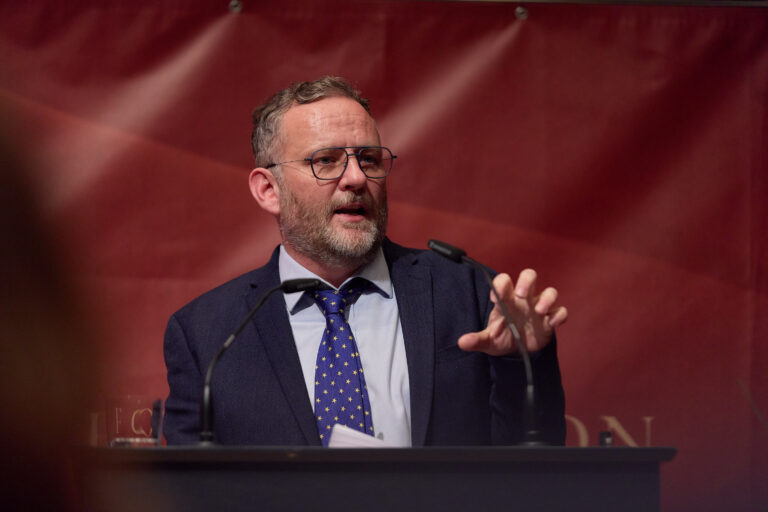
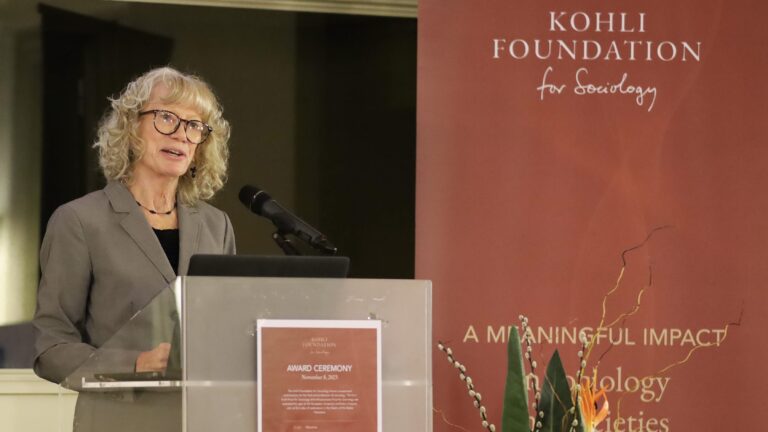
The Kohli Foundation for Sociology awards two prestigious science prizes each year: the Kohli Prize for Sociology and the Infrastructure Prize for Sociology. The Award Ceremonies take place alternately, one year at the WZB in Berlin and the following year at the EUI in Fiesole/Florence.
The Kohli Prize for Sociology honors exceptional achievement in and contributions to the field and profession of sociology. The Kohli Prize is rewarded with 50.000 EUR. It is awarded by an international Selection Committee composed of the Board of Directors, the Board of Trustees and two additional members from other world regions.
Nominees
Nominees should have made a significant imprint on sociological knowledge. The nominee is expected to deliver an address at the Award Ceremony, to be held in alternate years at the Berlin Social Science Center (WZB) and the European University Institute (EUI, Florence).
Nominations
The Kohli Foundation for Sociology is accepting international nominations for the Kohli Prize for Sociology on an ongoing basis. In addition, we send out a call for nominations each year. Nominations from previous years are kept on file and considered every year. A nomination can be submitted by a scholar based at any institution of higher learning and research (University, research institution, Academy of sciences). Self-nominations and posthumous nominations are not accepted. To diversify our laureate pool, the Kohli Foundation particularly welcomes nominations for women and scholars belonging to academically underrepresented groups. The nominations are confidential and should not be shared with the nominee prior to or after their submission.
Nomination Materials
The nominations must be written in English and should include a short summary of your nomination (150 words) and a full nomination (of about 1-2 pages) presenting a coherent argument for why you believe the nominee deserves to be awarded the Kohli Prize for Sociology. A nomination should also include a CV and publication list of the nominee as attachments. The Selection committee reserves the right to request follow-up documents if deemed necessary.
Important dates
8 FEBRUARY 2026
Deadline for the consideration for the Kohli Prize for Sociology 2026
The third Kohli Prize for Sociology was awarded to Peter S. Bearman, for his exceptional scholarly contributions to the sociology of movements, networks, health, and science, and for his remarkable ability to address important questions by bridging theory and empirical research.
Peter Bearman is Director of the Incite Institute and Cole Professor of Social Science in the Department of Sociology. He co-designed the National Longitudinal Study of Adolescent Health and is a specialist in network analysis and historical sociology. He is author of Doormen (University of Chicago Press, 2005) and with Adam Reich, of Working for Respect: Community and Conflict at Walmart (Columbia University Press, 2018). He is currently co-editor of the Middle Range Series and the Oral History Series at Columbia University Press. He is a member of the American Academy of Arts and Science, the National Academy of Science, and the National Academy of Medicine. His recent work focuses on the analysis of texts and narratives. He teaches introductory sociology, qualitative research design, research designs, historical sociology, social networks, and classical social theory.
Kohli Prize Laureate 2024
The second Kohli Prize for Sociology was awarded to Michèle Lamont for her incisive comparative studies of social boundaries and social worth that highlight the foundations of conflict and integration in contemporary societies.
Born in 1957, she grew up in Quebec and studied political theory at the University of Ottawa before obtaining a doctorate in sociology at the University of Paris in 1983. After completing post-doctoral research at Stanford University, she has served on the faculty at the University of Texas at Austin (1985-87), Princeton University (1987-2002) and Harvard University (2003-present). A cultural and comparative sociologist who studies inclusion and inequality, she has researched how we evaluate social worth across societies, the role of cultural processes in fostering inequality, symbolic and social boundaries, and the evaluation of knowledge, as well as topics such as dignity, stigma, racism, class cultures, collective well-being, social resilience, and social change.
Kohli Prize Laureate 2023
The first Kohli Prize for Sociology was awarded to Gøsta Esping-Andersen for his groundbreaking work on the comparative study of the welfare regimes and family demographics in capitalist societies.
Born in Denmark, he studied sociology, demography and economics in Copenhagen and Wisconsin, where he received his PhD. A highly successful career followed. Gøsta Esping-Andersen has held numerous teaching positions at various universities worldwide, and has cooperated on various high-level policy reports. He is also a member of the American Academy of Arts and Sciences and the British Academy. With his highly influential work “The three worlds of welfare capitalism” he set up a typology of welfare state regimes which has become the classical starting point of research in the field.
The Infrastructure Prize for Sociology
The Infrastructure Prize for Sociology honors substantial infrastructures that advance sociological knowledge. The prize is rewarded with 10.000 EUR. The Infrastructure Prize for Sociology is awarded by an international Selection Committee composed of the Board of Directors, the Board of Trustees and two additional members from other world regions.
Nominees
The nominee must have made a substantial impact on infrastructures that advance sociological knowledge. Such infrastructures can serve for data generation (e.g., large cross-national surveys), data preservation (e.g., archives), knowledge dissemination (e.g., learning platforms), fundamental research (e.g., setting up research institutes), or knowledge communication (e.g., science journalism). Persons, projects or organizations can be nominated. The nominee is expected to deliver an address at the Award Ceremony to be held in alternate years at the Berlin Social Science Center (WZB) and the European University Institute (EUI, Florence).
Nominations
The Kohli Foundation for Sociology is accepting international nominations for The Infrastructure Prize for Sociology on an ongoing basis. In addition, we send out a call for nominations each year. A nomination can be submitted by a scholar based at any institution of higher learning and research (University, research institution, Academy of sciences). Self-nominations and posthumous nominations are not accepted. To diversify our laureate pool, the Kohli Foundation particularly welcomes nominations for women and scholars belonging to academically underrepresented groups. The nominations are confidential and should not be shared with the nominee prior to or after their submission.
Nomination Materials
The nominations must be written in English and should include a short summary (150 words) of your nomination and a full nomination (of about 1-2 pages) including a description of the activity of the person/project/institution as well as a justification of how this infrastructure advances sociological knowledge. Nominations from previous years are kept on file and considered every year. The Selection Committee reserves the right to request follow-up documents if deemed necessary.
Important dates
8 FEBRUARY 2026
Deadline for the consideration for the Infrastructure Prize for Sociology 2026
The third Infrastructure Prize for Sociology was awarded to the SocArXiv, represented by Philip N. Cohen, for its accessible and timely contribution to the dissemination of sociological knowledge, having established itself as the leading platform for the early open sharing of research through preprint servers.
SocArXiv, open archive of the social sciences, provides a free, non-profit, open access platform for social scientists to upload working papers, preprints, and published papers, with the option to link data and code. SocArXiv is dedicated to opening up social science, to reach more people more effectively, to improve research, and build the future of scholarly communication.
Infrastructure Prize for Sociology 2024
The second Infrastructure Prize for Sociology was awarded to the European Social Survey, represented by Rory Fitzgerald, for their continuous monitoring of key social and political issues that has become indispensable for tracking change across European societies.
The European Social Survey (ESS) is a pan-European research infrastructure providing freely accessible data for academics, policymakers, civil society and the wider public. It was awarded European Research Infrastructure Consortium (ERIC) status in 2013. The ESS is an academically driven cross-national survey that has been conducted across Europe since its establishment in 2001. Every two years, interviews are conducted with newly selected, cross-sectional samples in around 30 countries on a wide range of subjects. With its European focus and excellent accessibility, the ESS is one of the outstanding infrastructure projects for sociology and related fields.
Infrastructure Prize for Sociology 2023
The first Infrastructure Prize for Sociology was awarded to Kathleen Mullan Harris, representing the Add Health Initiative, for her pivotal role in creating a unique longitudinal data set that allows to study individuals and their families in their social, behavioural, and biological dimensions across the life course.
Add Health is a multilevel, longitudinal, nationally representative study ofover 20,000 individuals who have been followed from adolescence throughmid-adulthood, and it is one of the most important, innovative, andwell-utilised data sets in the social sciences.
Kathleen Mullan Harris is James E. Haar Distinguished Professor of Sociology and Adjunct Professor of Public Policy. She has secured upwards of$100 million dollars in competitive research grants from the National Institutesof Health to run Add Health and played a crucial role in transforming Add Health into a landmark data infrastructure.